



Leaving a broken system isn’t always the right thing to do. And staying in one isn’t always wrong.
That’s the part people don’t like to say out loud.
You already know which choice you gravitate to, but that doesn’t make it easy to admit - even to yourself.
You justify staying as being strategic. Not burning bridges. Waiting for the right moment. Making incremental change.
Or maybe your shame runs the other direction. You walked out, and you’ve spent the years since wondering whether “I couldn’t be complicit anymore” is actually integrity or just a story you tell yourself when it’s quiet enough for doubt to creep in.
Both of those shames are real. (Ask me how I know.)
Last week I wrote about Dr. Robert Malone resigning from ACIP - about When Winning Requires Sacrifice - what leaving costs, what it buys us, and what we owe the people willing to pay that price.

And then I posted again about my own experience leaving medicine.
Within six hours it had been reposted over 500 times - once every forty seconds - and by the following morning over 100,000 people had read it.

But the virality wasn’t the part that stayed with me. What stayed with me was who showed up in the replies.
A PharmD who left her career after her own child had neurological reactions to a medicine she routinely administered. With a decade of higher education on her resume, she knew the science. She saw it happen. She reported it. And she was told not to believe her own eyes. She lost everything long before she left.
A senior HR leader who walked away from her job, her retirement, her colleagues, and what she called “a very nice life” - with eighteen months left - because she refused to cooperate with a mandate she knew was wrong.
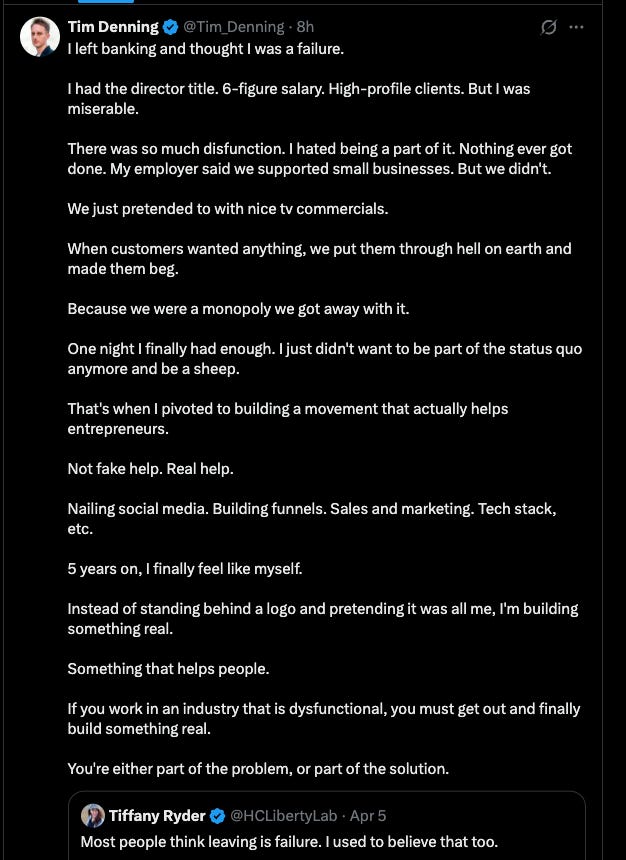
And then my friend and mentor, Tim Denning, who spent a decade in corporate banking while quietly losing his mind inside it. Two layoffs. Mental illness he does not soften when he talks about it. When he finally left, a former colleague told him he’d crossed over to the other side - unemployable. He knew, and he left anyway.
After gaining a bazillion subscribers and building a 7-figure business, he spends so much time with his family and his baby girls that his neighbors think he’s a bum or a felon and he just can’t find a job.
He doesn’t care. He’s happy. He finally feels like himself.
None of these people were trying to be heroes. They just hit a line they couldn’t cross.
I was one of them.
Except none of them hailed from the ER. None of them were talking about medicine. Because the truth about the choice to leave or stay isn’t actually about medicine at all.
Institutions are simply humans at scale. We know what’s real. We choose self-preservation anyway. Institutions do that too.
And that’s the mechanism underneath every single one of these stories. The pharmacist, the banker, the HR director - they all hit the same wall. The institution they trusted, the one they’d given decades of their life to, looked at the truth and chose itself. And then it asked them to do the same.
If you’ve been inside a system long enough, you don’t need me to explain how that works.
There’s the project that gets reassigned. The question that stops getting answered. The colleague who is suddenly, inexplicably less available. Nothing dramatic enough to point to. Just the slow withdrawal of the conditions that made it possible for you to do your job with any integrity, until you start to wonder if you imagined it- and then you realize you didn’t.
Tim wrote it cleanly, “you’re either part of the problem, or part of the solution,” but is that absolutely true?
Not everyone who engaged with my post felt it was.

This made me uncomfortable.
And if you’ve ever left something you built your life around, you’ve already had this conversation with yourself. Was it integrity or was it escape? Did you leave because you had to, or because staying and fighting was just harder than you were willing to admit?
Andrew Zywiec came down on one side and many agreed with him.
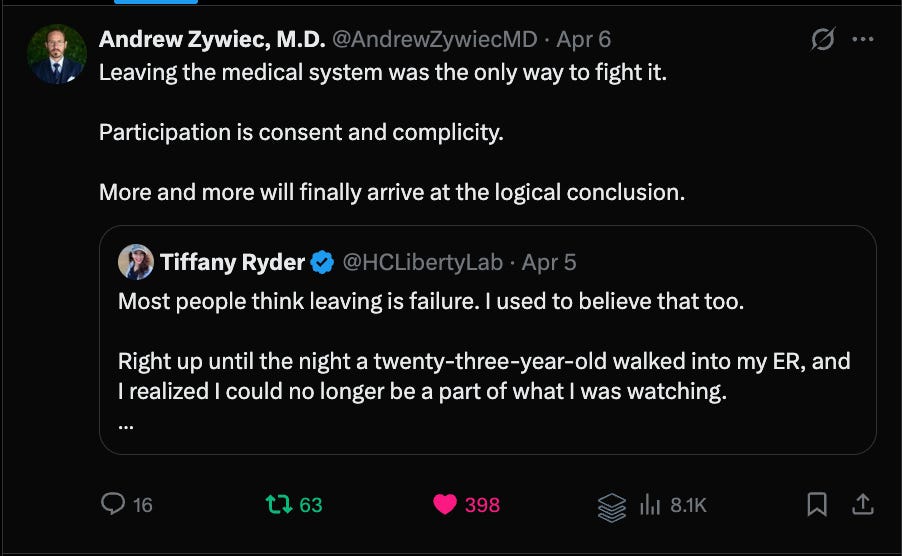
It’s a clean argument. And I understand why it resonates. And I actually feel it deeply myself. But brave isn’t clean.
The people who actually move the needle rarely fit the story we tell about them afterward - the one where the right choice was obvious and the person who made it knew exactly what they were doing.
That’s not how it works. That’s never how it works.
There are three ways people answer the question of what-to-do-once-ya-know:
Some people leave. They decide that participation is its own form of consent and they withdraw it, absorbing everything that comes with that - the lost income, the colleagues who stop calling, the identity they built carefully over years that is suddenly past tense. The pharmacist lost almost everything two decades before anyone was ready to listen. The HR director gave up her retirement with eighteen months to go. Their credibility now comes precisely from the fact that they have nothing institutional left to protect. You can’t threaten someone who already gave it up.
Some people stay. They make the opposite calculation - that two inches of movement from inside the room is worth more than any amount of noise from outside of it. The meetings no one will ever hear about. The relationships built over years. The strategic silence on the things that would get them removed, because they understand that if they leave, someone else sits down in their place. And if this is you, you’ve swallowed things that cost you something real. You’ve made peace with being misunderstood by people you respect, because you’ve decided the access is worth the price, and some days you’re sure about that. Some days, if you’re honest, you’re not. But it’s an act of courage.
Some people stay… until they can’t — and then leave in a way that changes something permanently on the way out. The soon-to-be-former Chief Medical and Scientific Officer of the FDA, Vinay Prasad, is a great example of this. He spent years inside medical institutions building credibility that’s nearly impossible to earn and can be destroyed in an afternoon. He survived pressure campaigns, public attacks, and the specific kind of slow institutional friction designed to make a person decide the fight isn’t worth it.
And when the choice came to hold-the-line or go-along-to-get-along, he chose the fight. He’s leaving in a way that makes it impossible to pretend certain things haven’t happened - not as an act of self-destruction, but as a final deliberate use of whatever runway he has left. There are people who will never forgive him for it. There are people who are better off because of it. Both of those things are probably true at the same time. (Which is usually how it goes with the people who actually change something meaningful.)
None of these are opposing camps. They’re different roles in the same fight, and the fight needs all of them.
The ones who leave make the silence visible. They give language and permission to the people still inside who are wondering, with some private relief, if they are the only one who’ve noticed what’s happening.
The ones who stay hold the seat so that when the window opens, someone worth listening to is still sitting in that room.
The ones who blow the door off on the way out make it impossible for the institution to pretend none of it happened.
The system benefits enormously when these people turn on each other (as they often do). When the ones who left call the ones who stayed sellouts, and the ones who stayed call the ones who left self-indulgent.
The system wants those arguments running on a loop, because they threaten no one and they change nothing and they keep everyone so busy pointing fingers that they don’t look at what’s happening inside the system itself.
And if you’re like me and you find yourself judging one of those groups a little too quickly or too harshly- it’s really worth asking which part of your own decision you are trying to justify.
You already know which group you are part of. Not the group that sounds better when you explain it to someone else, but the real one. The one you come back to when there’s no one watching.
And what I’m suggesting, is just own it.
All the way.
The shame you’re carrying, whichever direction it runs, belongs to the system. Not to you. Not to those who recognize the system for what it is. The person who left didn’t abandon anyone. And the person who stayed isn’t selling out. The person who’s still deciding isn’t a coward.
Brave is gray. It has always been.
The institutions want you to believe otherwise. They want you to believe there’s a bright clean line between the heroes and the sellouts - because people chasing a bright clean line are a lot easier to control than people who have made their peace with the gray.
Stop performing the version of yourself that fits more comfortably into whatever conversation you’re in. Because the reformers who actually change things are the ones who stop apologizing for exactly what they are.
You don’t have to ask yourself who you are, because you already know.
The only question left is whether you’re going to stop pretending that you don’t - and what it’s going to cost you when you do.

This article really hits home for me!
I have a really hard time playing the politician in these situations but, although I hate that the is the reality, I recognize that those who play the game are the only ones who can accomplish anything at all, usually.
Incredibly frustrating, but we have to work with the world that we live within, apparently 😋
Yes definitely. I think it’s just insecurity and something still to prove for us to so “other” people. And when we do it to our own side it’s particularly counterproductive. When we keep our eyes on the prize of the change we dream of and keep demanding it and explaining it and selling it - that inspires people to join us, it emboldens our quiet allies to get louder, and it makes it safer and more legitimate and credible for people to take our side and more uncomfortable for our enemies to perpetuate the status quo.