


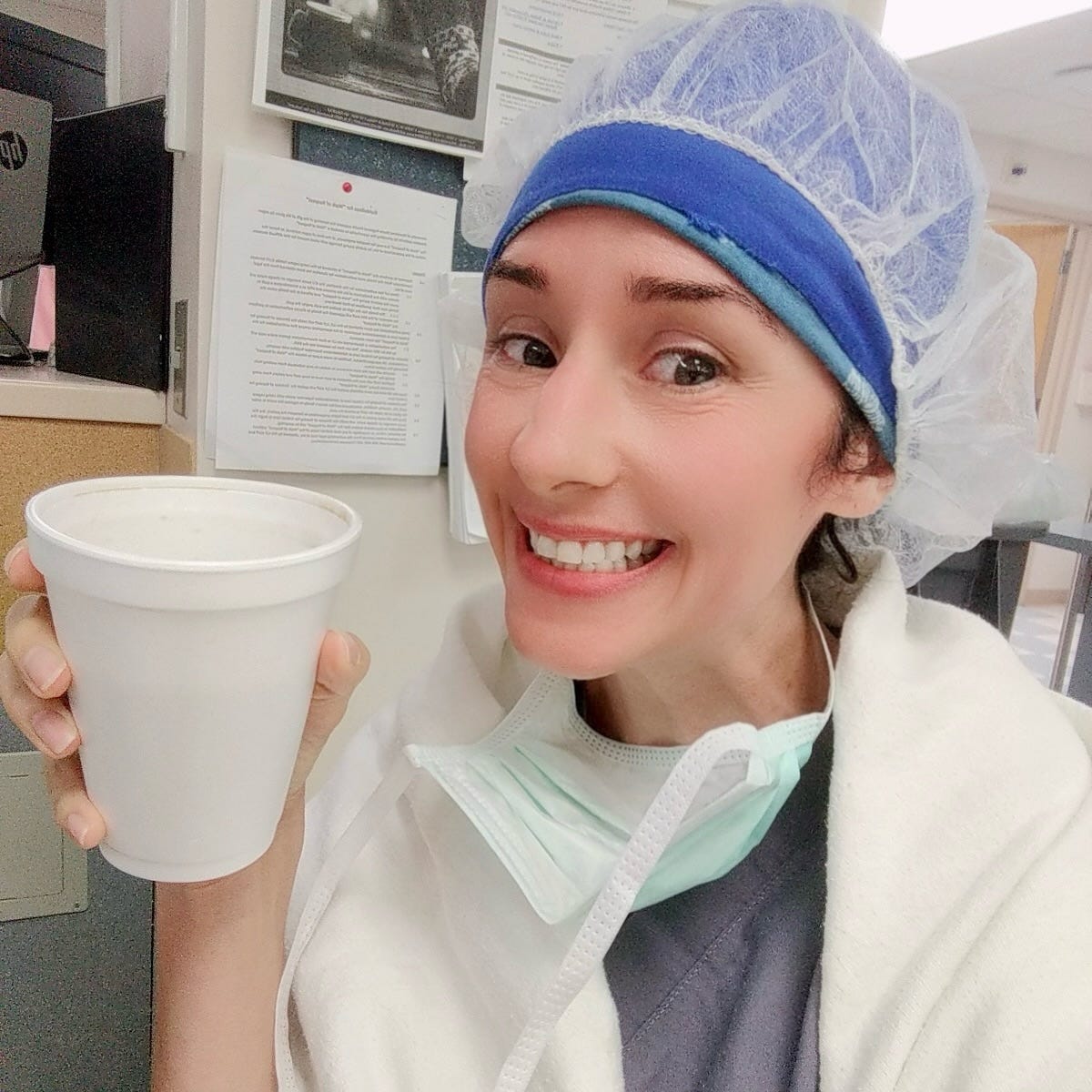
When I was working nights in the ER, nobody ever actually threatened my license. They didn’t have to. My loan balance did all the talking.
Years of training had bought me a career in emergency medicine and $250,000 in student debt. I knew I didn’t have the luxury of that career just “not working out.” At least as long as I believed the investment would only make sense if I stayed within hospital walls, earning the income I had spent years becoming qualified to earn.
I’d begun practicing during COVID.
And over and over, the protocols said one thing while my training dictated another.
Hospital protocol demanded abdominal CTs for patients with belly pain but no tenderness on exam. Every one of my professors had explained exactly how this was supposed to go and they would have failed me for ordering that test. Monoclonal antibodies were saving the lives of my patients early on, then suddenly we were told to stop and use “Run-Death’s-Near,” I mean, Remdesivir instead.
A 22-year-old woman came in with mini-strokes that began days after the mandatory vaccine her college required. When I asked about VAERS reporting, timing, I was told, wasn’t reason enough to investigate. And then mifepristone started arriving in the mail, and women began showing up to the ER bleeding out, or with infections. The FDA had no requirement to report nonfatal complications, so that story went untold.
Every one of these contradictions kept me up at night. Every one of them had earned scrutiny.
I wanted to ask questions openly, but before I’d figured out how to even say what was bothering me, I was calculating what saying it would cost. I’d spent years training to exercise my judgment and now I was busy deciding how much of it I could actually afford to express.
I know I am not the only one who does that kind of math.
I’m sure you’ve done a version of it in a meeting. You disagree with what’s being said, think about the consequences of speaking up, and you decide to let it go because - Well, heck! You need the job.
There is always a practical reason to wait.
The career I couldn’t afford to question
So by then, I had built much of my life around medicine. I had lived in Germany, learned German, and begun medical studies there before returning to America - before I’d finished. Once I was home, I helped run a diabetes prevention program across multiple states while working on research with Johns Hopkins Cardiology. The physicians there had encouraged me to continue my clinical training. They supported my applications. They wrote recommendations. They deeply believed I had something to contribute, and I believed them.
Becoming licensed gave me a way to put those years of work to use.
Questioning that decision and my career meant reconsidering a future I had spent years imagining, along with the expectations of people who had helped me get there.
I could change my mind about the work. But the student loans would still need to be paid.
At the center of all of the struggle is that I took the responsibility of communicating about health seriously. I saw people making decisions about their bodies and their families based on exactly what their clinicians told them. We owe patients brutal honesty about what we know and what we don’t know. That responsibility was why the certainty of the public messaging troubled me so much.
But I couldn’t separate the questions I wanted to ask from what might happen to my career if I asked them. I was trying to decide what I believed and what I could afford to do about it in the same breath. Each concern about my professional future made silence easier to justify for another day, while the things that bothered me remained completely unresolved.
Keeping quiet was tarnishing my soul.
The skills I’d been overlooking
As I started writing on the internet to explore these questions and process my thoughts, I did it mostly in the relatively safer space of healthcare financing and employee benefits.
I started encountering people who needed things I actually already knew how to do quite well. They needed help outlining an argument, explaining something complicated in plain language, or writing it in a way that would attract attention. I knew how to take information, find the point, and explain why anyone should care - that’s what I did at work every day.
Those requests grew into paid writing, editing, PR and communications work. I began to recognize value in abilities I had taken for granted because they came naturally to me. My research experience, clinical training, and years of explaining things to patients had given me skills desperately needed outside the hospital.
Maybe people already come to you for something, too. Maybe you’re the person who can explain a confusing process, organize something that feels overwhelming, or figure out why a problem keeps happening. You do it so often and so well that it barely registers to you as a skill. When something comes easily to you, it’s often hard to recognize what it might be worth to someone who needs help doing it.
I had been treating my investment in medicine as a reason it would be difficult to leave. But in reality what I had learned there was actively helping me build the next option.
Eventually, I left benefits and compliance and I built my own communications firm.
I grew it to $50,000 a month in income just to prove I could. Part of it was because I enjoyed the work and the challenge, but I was also proving that I could create safety for myself. I went to meetings in tank-tops, and I worked whichever 16 hours of the day I wanted. But I knew that if I ever needed to walk away from a job, I could support myself… and a small village.
It didn’t start out that way. In the beginning, people needed help with work I could do, and I helped them - for free. I was grateful. And as those requests grew, so did my confidence that the career I had trained for was only one of several ways I could earn a living.
The freedom to take the job
After 2 years on my own, I closed my firm to join CrowdHealth.
I had spent my life wanting to practice medicine to help patients. And throughout my clinical career, I had been frustrated by the way we pay for healthcare and whose interests that payment system actually serves. CrowdHealth, provided an opportunity to work on THAT problem with a team of motivated, brilliant renegades who wanted what I wanted - patient sovereignty.
As a member of CrowdHealth I’d seen the team providing real value — working to bring a patient’s bill down, helping people understand their choices, and giving them someone to call when navigating healthcare became overwhelming.
I really loved that. (I still do).
I hadn’t felt that alignment between the organization’s priorities and the patient’s interests in the hospital. I hadn’t found it anywhere in medicine.
But at CrowdHealth, I did. I could put my communications skills behind an approach I believed in and help people understand an option they might otherwise never consider.
The same abilities that had expanded my OWN choices could help patients understand and expand THEIRS.
That was work I’d always wanted to do. But I DID NOT want the job.
I was stuck.
After all wasn’t freedom the whole reason I had left a W-2 forever? Until I realized that refusing the role just to prove I could remain self-employed, wasn’t freedom at all. What I’d actually built with my business was the freedom to choose, and now… it was sort of time to chose it.
Today, I’m still in that W-2 role.
And my boss has NEVER asked me to compromise what I believe is right. I get to do work I care about with people I believe in, knowing I could leave and support myself if following my conscience ever required it.
That knowledge has forever changed the power a paycheck has over me.
What changes when you know you can leave
Self-censorship is easy to fall into because each decision to keep quiet can seem reasonable. You think about the people who depend on you, the bills coming next month, and how long it would take to replace your income. You leave a question unasked or decide a disagreement isn’t worth it. Over time, those decisions start determining how much of your judgment you feel free to exercise.
For me, building another way to earn began with noticing what people already needed my help doing. I liked helping them. It became something I could develop and rely on. Each assignment gave me more evidence that I had useful skills beyond the role I felt so financially attached to and morally compromised by.
You may stay in your profession for the rest of your life. You may love your job and the people you work with. And yet having another option gives you room to keep choosing that work freely, and to speak honestly while you do it.
I spent years becoming qualified to practice medicine. And then I built a life where I could afford to question it.
—
P.S. My family and I were CrowdHealth members well before I joined the team. And if you’re looking for a different way to pay for healthcare, check it out below.
The link is commissionable or you can join at www.joincrowdhealth.com if you prefer 🧡
I did the same thing not too long ago. Freed myself from w2, then got “captured" by another w2 a few years later. Except I wasn't really captured, because now I knew I could do whatever I needed to going forward!
🎉🎉🎉🎉
Great job Tiffany! Congrats on everything. 🤗